AI Knowledge Base
Give every team a sourced, approved answer.
Tribble connects approved knowledge with CRM context, call insights, prior submissions, reviewer decisions, and outcomes so sales, proposal, security, customer, and product teams answer buyer questions with the right evidence, the right language, and the right owner attached.
Knowledge teams using Tribble include





Recognized by teams that need governed answers
Security, compliance, and knowledge teams use Tribble when answers need sources, owners, and review paths. G2 shows 175 reviews and Fall 2026 recognition for ease of use, admin, setup, and doing business.



The right response needs more than a document search
Buyers ask the same company question in different places: a sales call, an RFP, a security review, a follow-up email, a support escalation, a QBR, or a Slack thread. Tribble connects the documents, calls, CRM records, policies, approved claims, prior submissions, and reviewer decisions your team already uses so every team gets the same governed response with source, access rules, owner, and deal context attached.
What is an AI knowledge base?
An AI knowledge base retrieves and generates answers from company sources. For revenue teams, the useful version must cite sources, respect permissions, show ownership, and route uncertainty before answers reach buyers.
Best for governed buyer answers.
Tribble is strongest when teams need approved product, security, legal, proposal, and customer language across Slack, Teams, sales follow-up, RFPs, DDQs, and security reviews.
Every answer keeps source, owner, and permission context.
The system retrieves relevant evidence, generates a buyer-ready answer, shows confidence, and routes gaps to owners instead of exposing reps to stale or unsupported claims.
Repeated questions reveal what the company is not ready to answer.
Missing sources, conflicting claims, stale responses, and high-friction questions become operating signals for product marketing, security, sales, and proposal teams.
From scattered documents to governed response intelligence
Every response comes with the evidence, permissions, deal context, and review workflow a buyer-facing team needs before it leaves the company.
- 01
Connect sources
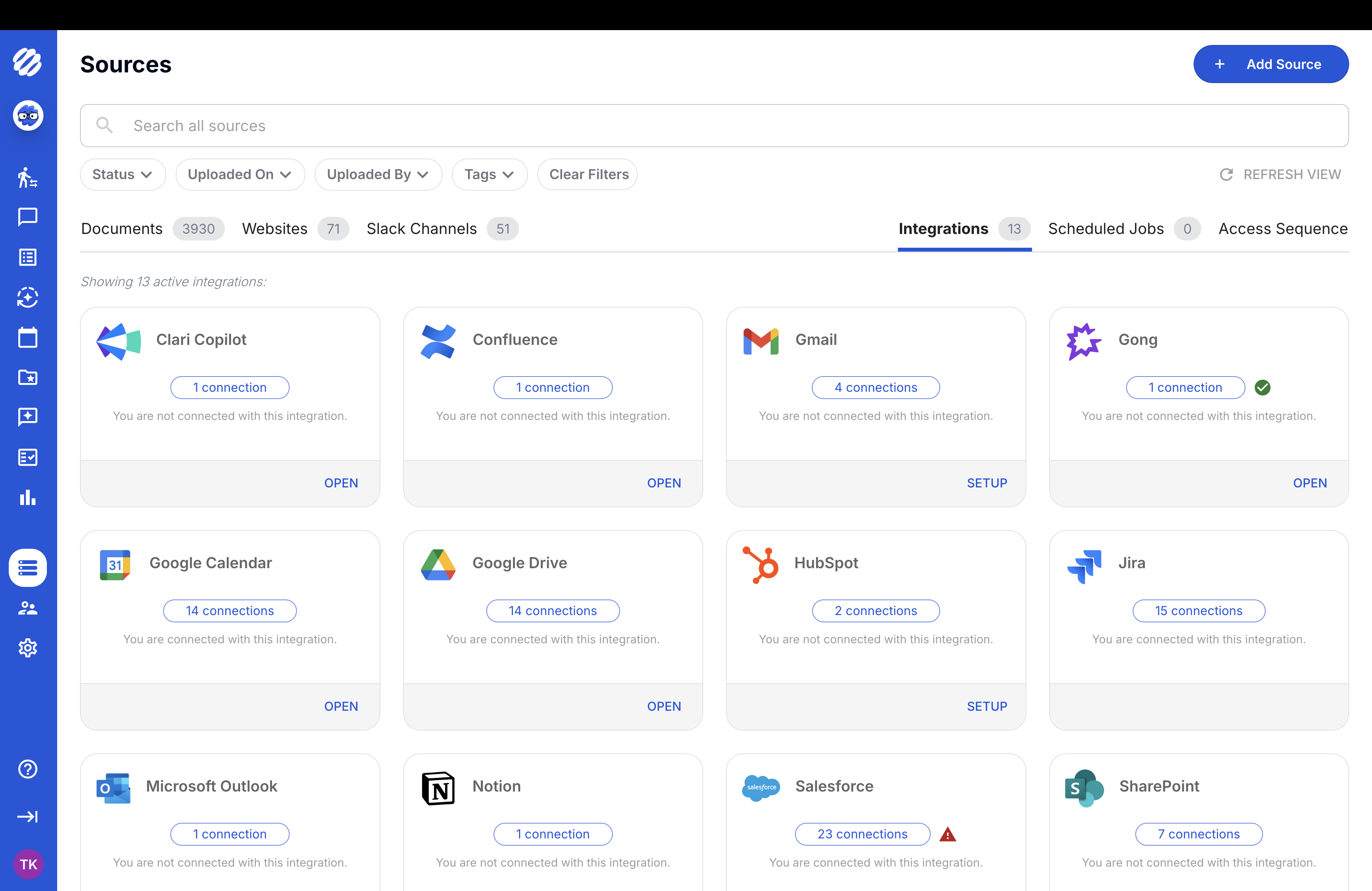
Documents, CRM, call recordings, wikis, proposal libraries, policies, and product content stay connected to the governed answer layer.
- 02
Retrieve context
The system finds relevant, current, permission-aware evidence instead of relying on a static answer library.
- 03
Return a cited response
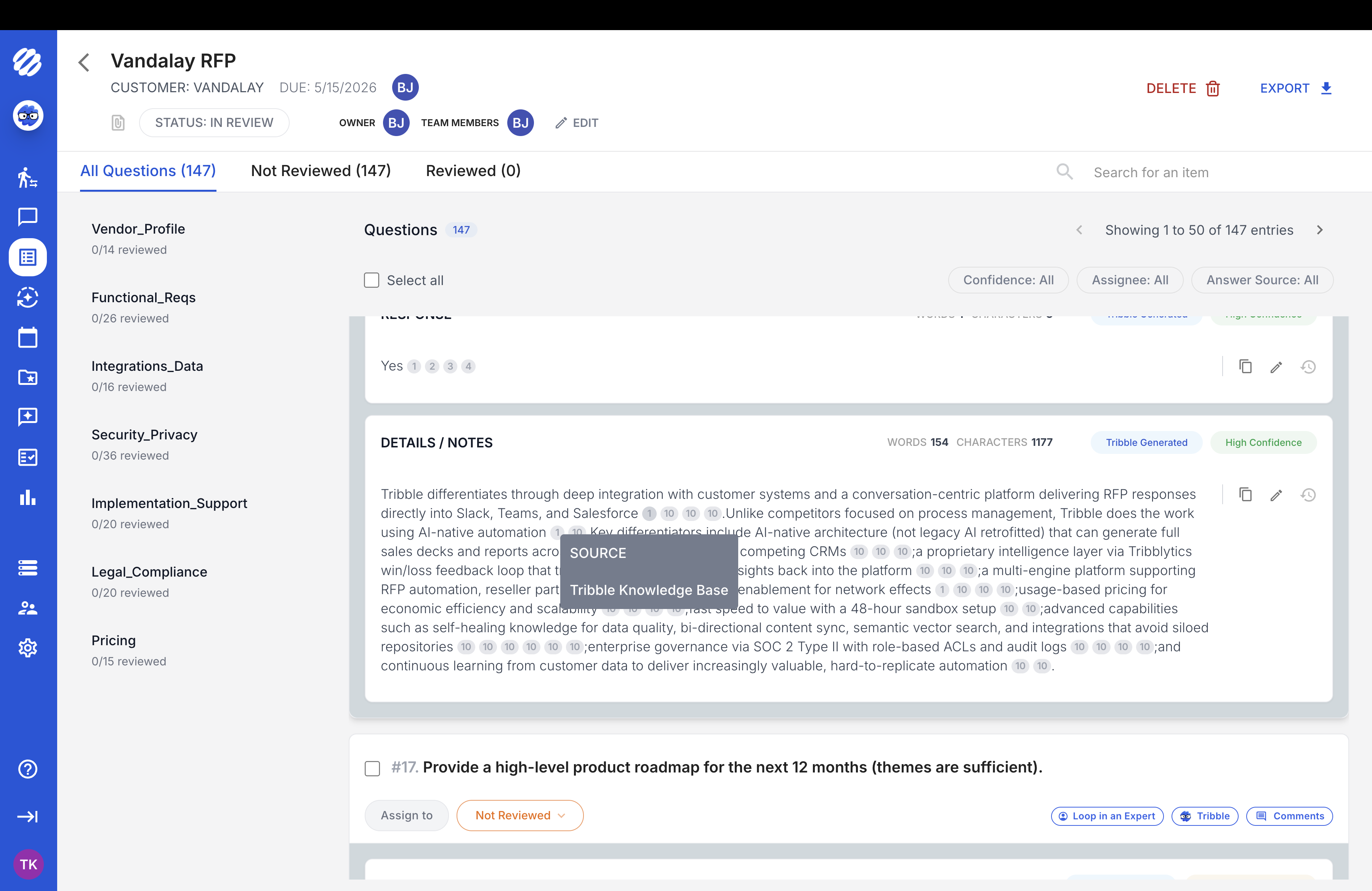
Teams see the answer, the source, and the review workflow before it moves into a buyer-facing response.
- 04
Improve the next one
Corrections, approvals, and outcomes strengthen future answers across proposals, sales conversations, and support workflows.
Search tools find content. Tribble gives teams the approved answer they can use.
The AI Knowledge Base is not just another wiki, search layer, or content library. It keeps source evidence, ownership, permissions, confidence, and workflow context attached when the answer moves into buyer-facing work.
They help teams find pages. The answer still has to be trusted.
Glean, Guru, Confluence, and SharePoint help people locate information. Tribble returns a source-cited answer with owner, permission, confidence, and workflow context already attached.
They organize assets. Reps still need the right answer for this buyer.
Highspot, Seismic, battlecards, and content libraries help store plays and decks. Tribble gives reps the approved answer for the buyer’s exact question, then reuses it in follow-up, proposals, and security reviews.
They manage projects. Tribble makes the knowledge available earlier.
Responsive, Loopio, RFPIO, Qvidian, and QorusDocs help run response work. Tribble makes the same governed knowledge available before the RFP arrives, during the sales cycle, and after submission.
Approved product, security, legal, and proposal answers show up everywhere.
Teams use Tribble for source-cited answers across internal questions, live sales conversations, DDQs, RFPs, security reviews, procurement, and customer follow-up.
| Tribble | Enterprise search and wikis | Enablement libraries | Response management | |
|---|---|---|---|---|
| What you get back | A governed answer | A list of pages | An asset or a play | A project and a library |
| Source attribution | On every answer | You open the document and judge | Whatever the asset says | A manual reference, if added |
| Permission aware | Checked before the answer is drafted | Whatever the index enforces | Library roles | Platform roles |
| Owner attached | Named, and routed to when uncertain | None | Asset owner | Reviewer queue |
| Available before the RFP arrives | It is the same layer either way | If somebody wrote the page | If somebody made the asset | The project starts when the RFP does |
| Learns from outcomes | Corrections, approvals and outcomes feed back | None | Usage analytics | Answer reuse |
What to look for in an AI knowledge base
A useful AI knowledge base should do more than find a nearby document. Teams need sourced answers, permissions, owner context, and a clear way to handle uncertain or high-stakes questions.
Can every answer show where the claim came from?
Look for source citations, source freshness, approved-claim handling, confidence signals, and the ability to distinguish current evidence from stale or conflicting content.
Does the answer respect access rules and ownership?
Enterprise systems should only retrieve permitted sources, show the answer owner, and route sensitive or uncertain questions to the right expert.
Does the answer appear where the team works?
Strong systems deliver approved answers in Slack, Teams, sales follow-up, CRM context, RFPs, DDQs, security questionnaires, and proposal workflows without fragmenting the source trail.
Does the system learn from repeated questions?
Missing answers, repeat questions, SME edits, rejected claims, and buyer objections should become operating signals for product marketing, security, sales, and content teams.
An answer with the proof and owner attached
Knowledge access, answer consistency, and gap visibility come from the same governed answer layer
Tribble keeps source evidence, owner, permission context, deal context, review workflow, and outcome history attached so answers can move from internal questions to buyer-facing work without losing trust.
Docs, policies, product content, and security evidence.
Sales reps, proposal managers, security reviewers, customer teams, and SMEs work from the same approved response layer.
CRM fields, buyer role, deal stage, and account history.
Policies, product docs, CRM records, call notes, approved responses, and subject-matter owners stay tied to the response.
Objections, competitors, and stated requirements.
Teams get the answer, source, permission context, confidence signal, and owner trail before it becomes a buyer-facing response.
Past submissions, approved edits, and outcomes.
Slack, Microsoft Teams, RFPs, DDQs, security reviews, sales conversations, and follow-up drafts all draw from the same layer.
Meet teams where the question appears, then keep the answer consistent everywhere
The AI Knowledge Base supports enterprise knowledge access, customer-facing answer consistency, and a clear view of missing, stale, or conflicting answers across the revenue team, then shows up in the daily moments where answers usually drift.
Give every team instant answers from approved company knowledge.
A rep, SE, CSM, proposal manager, or security reviewer asks in Slack or Teams. Tribble returns a source-cited answer with access rules, owner context, confidence, and the evidence path attached.
Keep sales, security, support, CS, and proposal teams saying the same thing.
The same approved answer can support a sales follow-up, implementation question, support escalation, QBR prep, procurement review, RFP response, DDQ, or partner enablement request.
See what the company can answer, cannot answer, or should not answer yet.
Tribble surfaces unanswered questions, stale claims, conflicting language, missing sources, and repeated questions by team, segment, product, or vertical before they become buyer-facing risk.
The two questions this gets asked most
Security team verifying language“Is our HIPAA questionnaire language still current?”
Compliance reviewer checks whether the standard questionnaire response matches the latest legal review. The knowledge base shows the source doc version, last reviewer, and approval date. No hunting through SharePoint.
Manager building competitive context“What have we said about Competitor X in the last 90 days?”
Sales manager pulls competitive positioning from recent winning proposals, call notes, and approved battlecards. One governed view replaces searching email, Slack, and four different folders.
“We need the approved answer, the evidence behind it, and a clear owner if the answer has changed.”
What response teams are really asking for
Use the same trusted response intelligence across RFPs, DDQs, and security reviews
When a buyer asks for proof, the answer already carries the policy, evidence, reviewer, and version your team trusts.
RFP Automation
Turn approved knowledge into faster, stronger proposal drafts. For teams with proposal deadlines, SME bottlenecks, and response reuse to solve.
DDQ Automation
Answer investor diligence from governed fund and operating knowledge. For financial services teams facing ODD, investor DDQs, and fund and operating questions.
Security Questionnaires
Give risk reviewers answers with the policy, evidence, and owner attached. For vendor risk, SOC 2, ISO, HIPAA, and procurement reviews.
Every response carries its source, permissions, and audit trail
The AI Knowledge Base operates within the same governed framework as the full Tribble platform: source citations, permission-aware retrieval, expert routing, and no model training on customer data.
Same approved content, tailored to how each buyer expects answers
A security review, investor DDQ, and health system RFP all need different proof. Tribble keeps the source of truth shared while the answer matches the reviewer’s world.
Financial Services
Fund, risk, operating, and investor diligence knowledge. For DDQs, ODD, and investor questionnaires.
Healthcare
Clinical, privacy, security, and health system procurement knowledge. For teams answering health system and payer requests.
Enterprise Tech
Technical, security, architecture, and competitive knowledge. For sales engineers and security reviewers at scale.
See what answer hunting costs your team
Estimate the time lost to repeat questions, SME interruptions, new-hire ramp, and searching through old content, then decide whether the knowledge base starts alone or connects into proposals and sales agents.
Start here when finding the right answer takes longer than writing the response
The knowledge base can stand alone for repeat buyer questions or become the shared source layer for proposal automation and sales agents.
- Best first step when teams are stuck searching old content or waiting on SMEs.
- Expands naturally into RFP, DDQ, and security response workflows.
- Connects to sales agents when reps need governed answers before and after calls.
- Packaging depends on source systems, users, review workflows, and workflow scope.
Practical guides for teams replacing response hunts
What is an AI knowledge base?
How a governed answer layer differs from a wiki, a search tool, and a content library.
Use one knowledge base across RFPs, DDQs, and security reviews.
How response teams work from a single approved layer instead of three.
Show the cost of repeat questions.
Model the hours your team loses to answer hunting, and what returns when it stops.
Know how governed response intelligence rolls out safely
The questions asked before a rollout.
Is this replacing our RFP, DDQ, or security workflow?
No. Tribble gives RFP, DDQ, and security workflows the approved answers, sources, and owners they need. The response process still fits the way each team works.
Can teams use it inside Slack or Microsoft Teams?
Yes. Knowledge delivery and expert routing can happen in the tools where teams already ask questions and coordinate responses.
How do we know an answer is current?
Each answer includes source context, and uncertain answers can be sent to the expert or system of record responsible for the knowledge.
Where does a buyer start?
If the urgent problem is a response deadline, start with RFP, DDQ, or security questionnaire automation. If the urgent problem is scattered knowledge, start here.
How should teams evaluate AI knowledge base software?
Evaluate whether the system returns source-cited answers, respects permissions, shows ownership, routes uncertainty, delivers answers inside revenue workflows, and turns repeated questions into readiness signals.
How is Tribble different from enterprise search?
Enterprise search finds documents. Tribble produces a governed answer with source, owner, permission, confidence, workflow, and reuse context attached.
How does an AI knowledge base prevent risky answers?
Risky answers are controlled through approved sources, permission-aware retrieval, confidence signals, SME routing, audit history, and review rules for stale or sensitive claims.